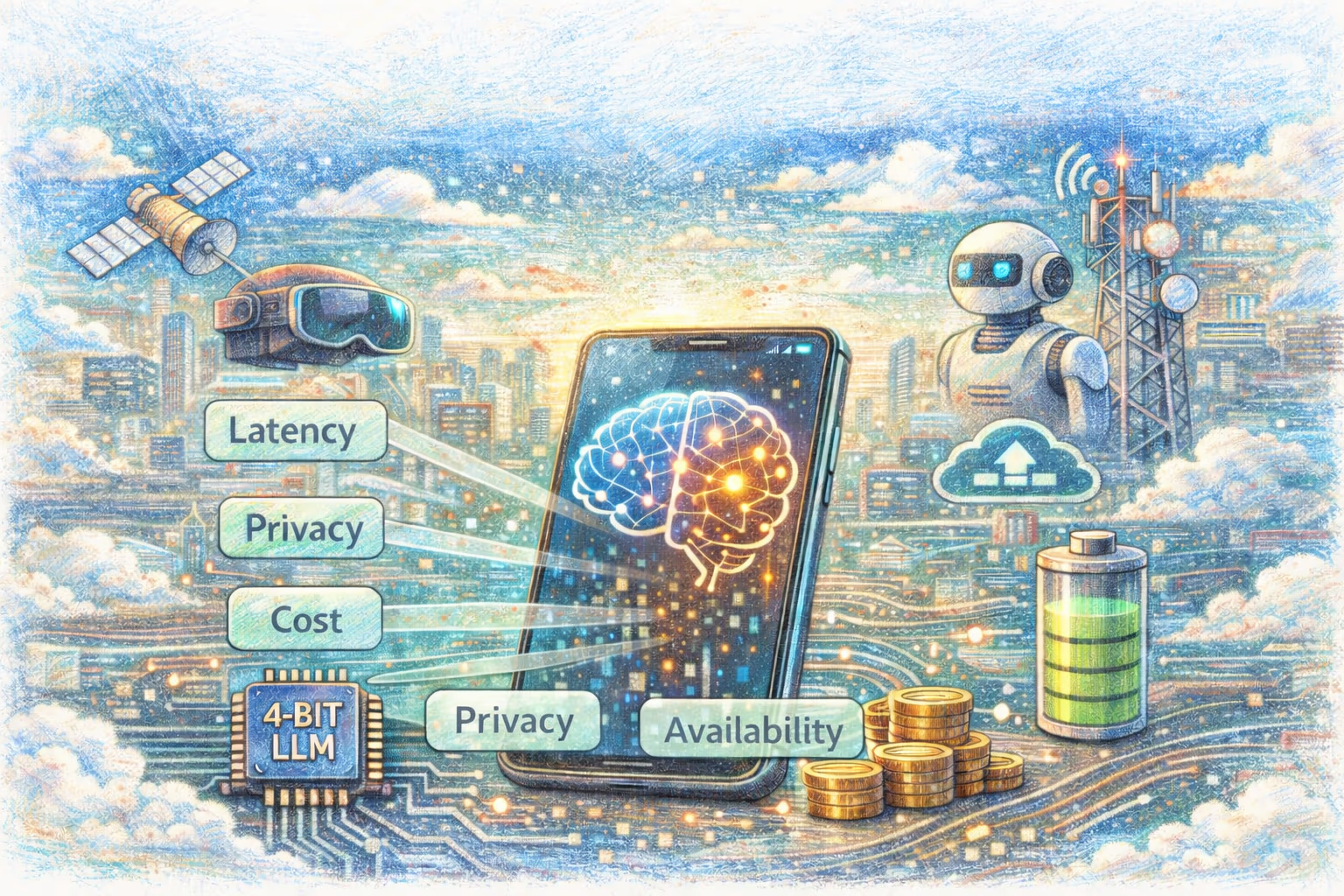
On‑device AI: Bringing Intelligence to the Edge
On‑device AI runs machine learning models directly on user devices—smartphones, wearables, IoT sensors, and edge gateways—rather than relying solely on cloud inference. As hardware accelerators, optimized runtimes, and efficient model techniques have matured, running intelligence locally has become practical and strategic for many products.
Why on‑device AI matters
- Low latency: Local inference removes network round trips, enabling real‑time interactions such as augmented reality, live translation, and immediate camera effects.
- Privacy by design: When data and inference stay on the device, products can reduce exposure of sensitive information and simplify compliance for biometric and health scenarios.
- Offline reliability: Local models keep features functional without network connectivity, crucial for remote environments or spotty mobile coverage.
- Lower bandwidth and cost: Fewer cloud requests reduce operational expenses and conserve user data usage.
- Personalization: Models can adapt to individual behavior locally, enabling private, personalized experiences with fast feedback loops.
Key use cases
- Mobile UX: Smart keyboards, smart watch, on‑device speech recognition, camera scene detection, and image enhancement.
- Wearables & healthcare: Continuous monitoring, anomaly detection, and on‑device alerts while preserving patient privacy.
- Industrial IoT: Real‑time fault detection and control where latency or connectivity constraints preclude cloud dependence.
- AR/VR & robotics: Low‑latency perception and control for immersive and safety‑critical systems.
- Smart home: Local automation and voice understanding without mandatory cloud access.
Technical enablers
- Model compression: Techniques such as quantization, pruning, and weight sharing reduce size and compute cost.
- Knowledge distillation: Large teacher models transfer knowledge to smaller student models optimized for edge devices.
- Efficient architectures: Mobile‑first networks (e.g., MobileNet, EfficientNet‑lite) and edge‑tuned transformers trade parameters for latency.
- Edge runtimes: TensorFlow Lite, Core ML, ONNX Runtime Mobile, and TVM provide graph optimizations, operator fusion, and hardware backends.
- Hardware accelerators: NPUs, DSPs, and embedded GPUs dramatically reduce energy per inference on modern SoCs.
- TinyML: Ultra‑low‑power inference on microcontrollers enables sensor‑triggered intelligence in constrained environments.
- Federated learning & split inference: Decentralized training and hybrid pipelines keep raw data local while allowing global model improvements.
Challenges and tradeoffs
- Accuracy vs. size: Compressing models can reduce accuracy; balancing task needs with resource budgets is essential.
- Energy & thermal limits: Continuous or heavy inference affects battery and device temperature; use duty‑cycling and event‑driven inference.
- Security: Protect models from tampering and extraction—use signed updates and secure enclaves where possible.
- Lifecycle management: Updating models across a fragmented device fleet needs robust versioning and rollout strategies.
- Device heterogeneity: Diverse hardware and OS capabilities expand testing surface and complicate optimizations.
Organizational considerations
Delivering on‑device features requires cross‑functional collaboration: ML engineers, embedded/firmware teams, product managers, and security/compliance stakeholders. Expect higher engineering effort up front and potentially lower ongoing cloud costs. Bring legal teams into the loop for regulated domains such as healthcare and finance.
Future outlook
Hardware will continue to improve (wider NPU availability and greater on‑chip memory), and software tooling will keep pushing capabilities to the edge. Advances in continual on‑device learning, better federated methods, and tighter hardware/software co‑design will expand the complexity of tasks that can run locally. The most likely future is hybrid: heavy training and model orchestration in the cloud, with fast, private, personalized inference on device.
Conclusion
On‑device AI reshapes product design beyond a technical optimization: it influences user experience, privacy posture, and operational cost. When implemented thoughtfully—balancing accuracy, latency, energy, and security—it unlocks resilient, private, and immediate experiences that were previously impractical.
Pros vs Cons
| Pros | Cons |
|---|---|
| Low latency — enables real‑time UX | Limited model capacity compared to cloud-scale models |
| Privacy by design — sensitive data stays local | Higher device engineering and testing effort |
| Offline reliability | Battery and thermal constraints for sustained inference |
| Lower bandwidth and operational cost | Fragmentation across hardware and OS increases optimization complexity |
| Personalized, private experiences | Secure model updates and lifecycle management add operational overhead |
Links
- https://v-chandra.github.io/on-device-llms/
- https://www.liquid.ai/blog/introducing-lfm2-5-the-next-generation-of-on-device-ai
- https://github.com/ggml-org/llama.cpp
- https://www.raspberrypi.com/news/introducing-the-raspberry-pi-ai-hat-plus-2-generative-ai-on-raspberry-pi-5/
- https://www.lemondeinformatique.fr/publi_info/lire-ia-embarquee-un-choix-uniquement-technologique-1355.html